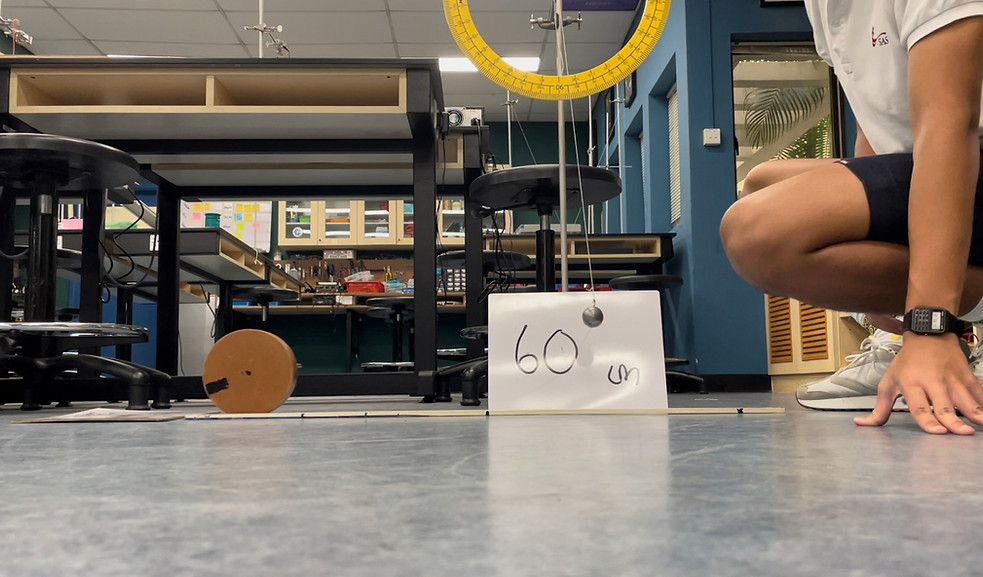
Pendulum Pulling on a Cylinder
By Arvino Mahadi
Introduction
As a pendulum swings, the momentum of the bob constantly changes. This momentum also varies depending on certain characteristics of the pendulum. When another string is attached to the bob, connecting it to something like a cylinder, this momentum can be transferred. This experiment will explore the relationship between the length of the pendulum and impulse and how it affects the motion of the cylinder. I chose the length of the pendulum as my independent variable because I know that it affects the initial height of the pendulum bob, which is related to energy, and I know that it affects the angular velocity and the overall characteristics of the motion of the bob, which are related to momentum. To explore this relationship I came up with the following guiding questions:
How does the length of the pendulum affect the linear and angular velocity of the cylinder?
How is the energy from the pendulum distributed between the translational and rotational energies of the cylinder?
How does the length of the pendulum affect the time of the impulse?
How does the length of the pendulum affect the force it exerts onto the cylinder?
To answer these guiding questions the experiment was designed with these required materials: a retort stand, a protractor, a pendulum bob, string, and a cylinder. A ruler was used to measure the radius of the bob and the cylinder and a scale was used to measure the masses of the bob and the cylinder. A meter stick was used to measure the length of the pendulum and was used as a measuring reference in the video analysis. To set up the experiment, a string was attached to the retort stand, connecting it with the bob, creating a pendulum. Another piece of string was taped onto the bob with the other end being attached around the circumference of the cylinder. The height of the pendulum must always be adjusted to make sure that when the string attaching the bob and the cylinder is taut, it is parallel to the ground. This will ensure that the tension forces exerted on the bob and the cylinder are parallel to their instantaneous motions. The cylinder needs to but positioned in a way so that the string is taut when the pendulum bob is at its lowest point. The initial angle of the pendulum was set at 15 degrees to ensure accurate simple harmonic motion calculations.
There were four trials conducted to vary the length of the pendulum: 44cm, 60cm, 78.5cm, and 85.5cm. These are the lengths from the pivot point to the surface of the bob and the radius of the bob was accounted for in the calculations and the computational model to ensure the true length from the pivot point to the center of mass of the bob. After recording the videos for the successful trials, Logger Pro's graphical analysis was used to analyze the motions of the pendulum and the cylinder. Values found from the graphical analysis were then used for the calculations and the coded animation (VPython).